Choosing Entrepreneurship Over Salaried Work When in Poverty
For individuals living in poverty, self-employment is often seen as a possible route toward greater financial independence. Yet the risks involved can feel like navigating between Scylla and Charybdis, an ancient metaphor describing two difficult choices where each option carries significant danger. New research presented by Dr. Nastasya Winckel and Dr. Paul Lewin explores whether entrepreneurship truly offers a viable strategy for the working poor or whether it exposes them to new forms of economic vulnerability.
What the Study Examined
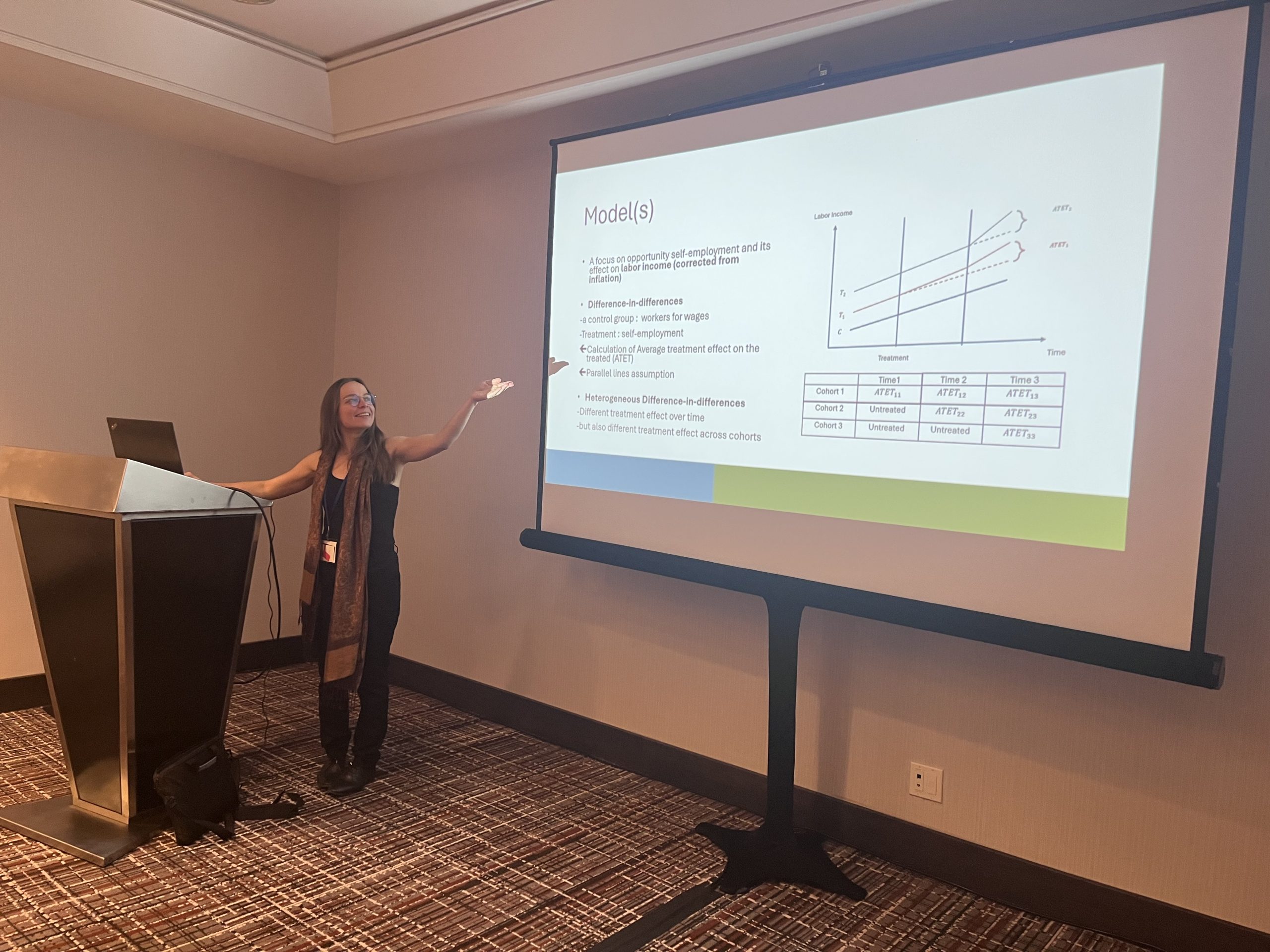
The research investigates households that move from wage work into self-employment to determine how their labor income changes over time. Using data from the Panel Study of Income Dynamics (PSID) between 2003 and 2021, the authors apply a difference-in-differences approach to compare outcomes for workers who stay in wage employment and those who transition into entrepreneurship. The analysis focuses specifically on individuals who were poor during the years leading up to the transition, as well as a comparison group of wealthier households.
The study aims to understand whether entrepreneurship pays off differently depending on a household’s poverty status and how these effects change across economic cycles.
Key Findings
Across most cohorts, entering self-employment resulted in lower labor income compared with staying in wage work. This pattern appeared for both poor and wealthier households, although the drop in income tended to be smaller among the working poor. Individuals entering self-employment during periods of economic instability experienced even larger declines, suggesting that economic cycles shape both the decision to pursue entrepreneurship and its financial outcomes.
The results also varied widely across cohorts, indicating that entrepreneurship is not a uniform experience. While many individuals faced negative financial outcomes, the magnitude of these losses differed depending on when they entered self-employment and how long they remained self-employed.
Long-Term Entrepreneurship and the Working Poor
A central question of the study was whether sustained self-employment might eventually lead to improved outcomes for the working poor. The findings suggest that staying self-employed for only a short period often leads to negative financial results. However, some individuals who remained in self-employment for multiple periods experienced outcomes that were less negative and, in certain cases, closer to break-even levels.
These mixed results highlight the complex nature of entrepreneurship for the working poor. While long-term self-employment may help some individuals overcome initial disadvantages, the overall financial payoff remains uncertain.
Individuals who left wage work for self-employment generally experienced a decline in labor income, yet the size of that decline was often smaller among those who were already poor. These patterns suggest that while entrepreneurship may offer non-financial benefits, such as autonomy or flexibility, the financial gains that many hope for are not guaranteed. Because outcomes varied widely across cohorts, the results point to a complex landscape in which risks and rewards depend heavily on timing, economic conditions, and individual circumstances.